

Introduction to AI Agents and Virtual Assistants
The rise of technology has brought forth numerous innovations that have significantly altered the way individuals and businesses operate. Among these innovations are AI agents and virtual assistants, two prominent forms of artificial intelligence that serve distinct yet overlapping purposes. Understanding the difference between AI agents and virtual assistants is crucial as we move towards a more automated future, particularly by the year 2026.
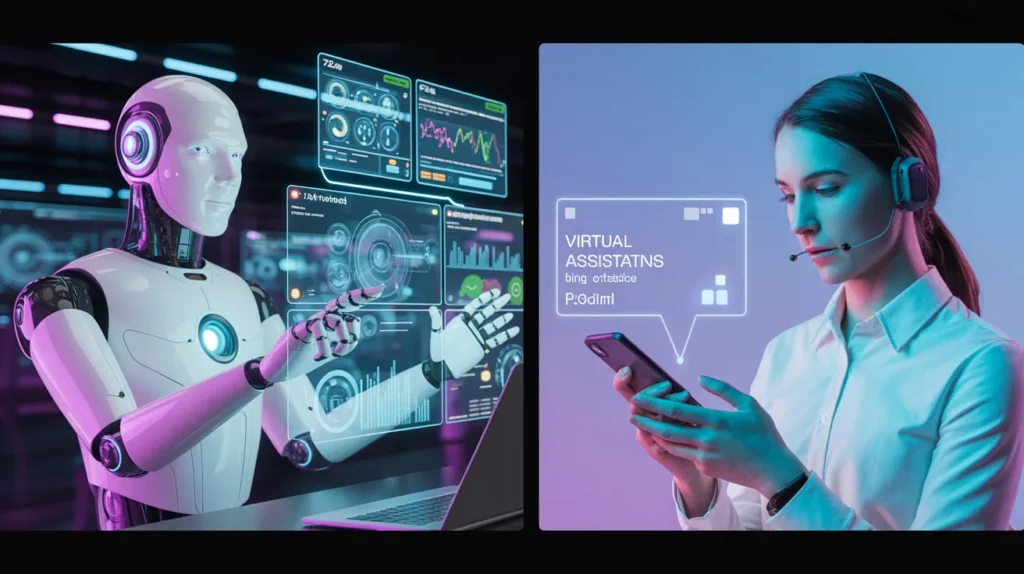
An AI agent can be broadly defined as an entity capable of perceiving its environment and acting upon that information to achieve specific goals. These agents learn from experiences, directly interacting with their surroundings to make decisions or perform tasks autonomously. They are equipped with advanced algorithms that enable them to adapt to different scenarios, providing dynamic responses tailored to user needs. On the other hand, a virtual assistant is a more specialized application of AI technology, designed to perform tasks or services for an individual based on voice commands or text inputs. Typically, virtual assistants are embedded in smartphones, smart speakers, and various applications, helping users manage daily tasks efficiently.
The origins of these technologies trace back to the early days of artificial intelligence research, which sought to create systems that could mimic human-like understanding and behavior. As computing power and algorithms have evolved, so too have the capabilities of AI agents and virtual assistants. Today, these tools are not only essential for personal use but also play critical roles in businesses, streamlining operations through AI automation tools.
As we look ahead to 2026, the evolution of AI agents is poised to reshape both personal and professional landscapes. We can expect a surge in AI agents for small businesses, offering customized solutions to enhance productivity and decision-making. Moreover, the best AI agents in 2026 will likely display capabilities that outstrip those of current technologies, solidifying their role as indispensable assets in the digital ecosystem.
Understanding AI Agents
AI agents represent a sophisticated echelon of artificial intelligence technology, distinct from traditional virtual assistants. These agents are designed to perform tasks autonomously, utilizing advanced algorithms and learning mechanisms that enable them to make decisions without human intervention. At their core, AI agents are equipped with both machine learning and natural language processing capabilities, allowing them to understand and respond to user requests with a degree of nuance that often surpasses that of typical virtual assistants.
The core functionality of AI agents lies in their ability to analyze data in real-time, draw from vast knowledge bases, and apply this information to improve their performance and the accuracy of their outputs. For instance, when comparing the difference between AI agents and virtual assistants, it’s essential to recognize that AI agents not only execute predefined tasks but also learn from previous interactions to enhance future engagements. This learning process enables them to adapt and evolve, positioning them as invaluable AI automation tools for businesses seeking efficiency and innovation.
In 2026, the landscape of AI agents is expected to undergo significant transformation, with advancements leading to the integration of more complex decision-making abilities. Industries such as finance, healthcare, and retail are already harnessing the potential of AI agents for tasks ranging from predictive analytics to customer service enhancements. In the realm of small businesses, the adoption of AI agents is likely to democratize access to high-level computational power, which was previously reserved for larger enterprises.
Understanding how AI agents work is essential for businesses looking to implement these technologies effectively. They utilize various AI virtual assistant tools to process user input, synthesize responses, and maintain context over conversations. As we look into the future of AI agents, it is clear that they will play a pivotal role in shaping how organizations operate and engage with customers, marking a significant evolution in the relationship between humans and technology.
Understanding Virtual Assistants
Virtual assistants are software applications designed to assist users in various tasks through voice recognition and natural language processing capabilities. They serve a critical role in enhancing productivity by automating routine activities and providing information on demand. Some popular examples of virtual assistants include Amazon’s Alexa, Google Assistant, Apple’s Siri, and Microsoft’s Cortana. These tools interact with users via voice commands or text input, making them easily accessible for daily tasks.
The primary functions of virtual assistants vary from setting reminders, managing calendars, to controlling smart home devices. They act as personal helpers, equipped to answer queries ranging from weather forecasts to complex task coordination. The key feature that distinguishes a virtual assistant from an AI agent is that virtual assistants usually follow predefined algorithms and provide responses based on programmed logic, whereas AI agents can leverage adaptive learning and smarter decision-making capabilities.
As we look towards 2026, the functionality of virtual assistants is expected to evolve significantly. Innovations in AI automation tools for business will likely lead to increasingly sophisticated virtual assistants that can understand context and intent more accurately. Improved machine learning techniques could enhance their communication abilities, making it possible for virtual assistants to anticipate user needs rather than merely reacting to commands. Furthermore, their integration with AI agents may lead to a blurring of lines between these two entities, fostering a new breed of digitally empowered assistants.
By 2026, we might see a broader adoption of AI virtual assistant tools in different sectors including healthcare, education, and small businesses. This adaptation could facilitate smoother interactions and streamlined processes, thereby transforming the way people engage with technology in both personal and professional contexts. As a result, understanding the difference between AI agent and virtual assistant will be important for users seeking optimal productivity tools.
Key Differences Between AI Agents and Virtual Assistants
The distinction between AI agents and virtual assistants is pivotal in understanding their respective roles and functionalities within business and technology landscapes. While both technologies leverage artificial intelligence, they serve different purposes and operate on varying levels of complexity.
AI agents are designed to function autonomously, often capable of handling a multitude of tasks without requiring constant user input. These systems are integrated with advanced algorithms and machine learning capabilities that allow them to learn from experience and adapt to new situations. Businesses are increasingly utilizing AI agents in 2026 for tasks ranging from customer service automation to data analysis, emphasizing their ability to enhance productivity and efficiency.
On the other hand, virtual assistants are primarily focused on user interaction and are typically designed to follow user commands or prompts. They are adept at executing predefined tasks like scheduling meetings or managing emails but fall short of the advanced decision-making abilities that AI agents possess. The virtual assistant vs AI assistant comparison highlights these differences clearly, as the former usually relies on user direction while the latter operates with more independence.
Furthermore, AI agents tend to possess superior data processing capabilities, enabling them to analyze large datasets in real time and offer insights that can drive strategic decisions. In contrast, virtual assistants excel in personal assistance roles but may not handle complex data requests that require deeper analytical insight. The rise of AI automation tools for business underscores the growing reliance on AI agents, especially for small businesses looking to compete in a data-driven environment.
As we move towards 2026, understanding the difference between AI agent and virtual assistant will be crucial for organizations aiming to optimize their operations. By leveraging the strengths of each, businesses can strategically deploy these technologies to meet their needs and drive growth.
Current Trends in AI Agents and Virtual Assistants
As we delve into the current trends surrounding AI agents and virtual assistants in 2023, it is important to recognize the rapid growth and transformation happening in this space. The difference between AI agents and virtual assistants has become increasingly nuanced, especially as advancements in AI technology are reshaping these tools. AI agents, which can perform complex tasks and exhibit autonomous behavior, are evolving in capabilities—projecting a promising future by 2026.
One of the notable trends is the shift towards personalized AI experiences. Businesses are leveraging AI automation tools for business to create tailored interactions between agents and users. This customization enhances engagement and ensures that both AI agents and virtual assistants understand user preferences more intuitively. Additionally, the integration of machine learning algorithms has enabled these technologies to improve accuracy and efficiency over time, addressing the limitations traditionally associated with virtual assistant vs AI assistant functionalities.
The impending rise of AI agents for small businesses is particularly noteworthy. As more entrepreneurs seek cost-effective solutions for managing tasks, AI agents are poised to provide significant support. The best AI agents of 2026 are expected to incorporate advanced features that not only automate mundane tasks but also offer insights into business growth and customer relations. The increasing reliance on cloud-based AI virtual assistant tools suggests a move towards more accessible and flexible solutions which can be implemented without the need for extensive IT infrastructure.
Furthermore, by 2026, we might witness the convergence of various AI technologies, creating seamless ecosystems where AI agents and virtual assistants coexist and complement each other. Understanding how AI agents work will be crucial for organizations aiming to enhance operational efficiency. Overall, the future of AI agents appears promising, driven by ongoing advancements in technology and a rising demand for intelligent solutions across various sectors.
Potential Applications of AI Agents and Virtual Assistants in 2026
As we look towards 2026, the difference between AI agents and virtual assistants becomes increasingly significant in various sectors. AI agents are likely to evolve substantially, becoming integral to industries such as healthcare, customer service, and education. In healthcare, AI agents could assist medical professionals by analyzing patient data to suggest personalized treatment plans, enhancing decision-making processes. With the integration of AI automation tools for business, healthcare systems can improve patient outcomes and streamline operations.
In the customer service sector, AI agents are expected to offer more advanced interactions than traditional virtual assistants. By utilizing natural language processing and machine learning, these agents will facilitate real-time customer support, resolving issues efficiently and enhancing the overall customer experience. The rise of AI agents for small businesses in 2026 will further enable these entities to compete with larger corporations, providing them with tools to automate inquiries, manage appointments, and enhance client communication.
The education sector will also witness significant advancements through AI virtual assistant tools. Educators can use AI agents to tailor learning experiences based on student performance, providing individual support at scale. Personalized learning, enhanced by AI agents, may lead to improved academic outcomes and increase accessibility to quality education for diverse learner populations.
As personal use expands, the potential for AI agents will only grow. From managing household tasks to providing recommendations based on user preferences, AI agents will become an indispensable part of daily life. This distinction between virtual assistant vs AI assistant will be magnified, as users seek more complex interactions and solutions. The future of AI agents in 2026 holds exceptional promise, suggesting that we are on the brink of a transformative era where traditional roles evolve and new applications emerge.
The Ethical Considerations of AI Agents and Virtual Assistants
As organizations increasingly implement AI automation tools for business, the ethical implications surrounding AI agents and virtual assistants come to the forefront. A critical area of concern is privacy, as these technologies often require access to sensitive personal information to function effectively. Without robust data protection measures, there is a risk that this data could be misused or inadequately protected, leading to potential breaches of privacy.
Another pertinent issue involves data ownership. As organizations leverage AI agents for small businesses and large enterprises alike, questions arise concerning who owns the data generated by these digital entities. The lack of clear regulations can create complications for consumers and businesses, as they navigate rights regarding the data they generate and share with AI agents and AI virtual assistant tools.
Job displacement is yet another ethical consideration. As technology evolves, there is an ongoing debate about the potential for AI agents in 2026 and beyond to displace human workers. While many agree that virtual assistant vs AI assistant roles can enhance productivity, there is concern around the impact on employment opportunities, particularly for lower-skilled workers. It is essential for developers and employers to assess their moral responsibilities in this regard, ensuring that the adoption of AI is accompanied by efforts to retrain and support affected workers.
Finally, the moral responsibilities of developers must not be overlooked. As creators of these technologies, developers ought to consider the ethical ramifications of their work. This involves not only maintaining transparency around how AI agents operate but also ensuring that urgent ethical concerns are addressed proactively. By engaging with these issues, the future of AI agents can be shaped to foster a more responsible and equitable technology environment.
Future Interactions between Humans and AI Technologies
The landscape of human interactions with artificial intelligence (AI) technologies is rapidly evolving. By the year 2026, we anticipate significant advancements in the capabilities of both AI agents and virtual assistants. These tools are being designed to not only perform tasks but to seamlessly integrate into our daily lives, enhancing productivity and user experience.
The difference between AI agents and virtual assistants lies in their functionality and interaction style. While virtual assistants like Siri or Alexa are primarily focused on voice-activated tasks, AI agents go beyond mere management of tasks by leveraging data analytics and machine learning to provide personalized recommendations and predictive services. For small businesses, the implementation of AI agents can lead to transformative outcomes, enabling more efficient customer engagement and business processes.
As AI agents in 2026 evolve, we can expect greater sophistication in their interactions. These AI automation tools for business will not only react to user commands but also initiate conversations based on context, further blurring the lines between human and machine interactions. The potential for AI agents will challenge the traditional frameworks of communication, necessitating a deeper understanding of user engagement.
However, the rise of AI technologies also presents new challenges. Issues surrounding privacy, data security, and the quality of human-AI engagement will become increasingly prominent. Moreover, navigating the virtual assistant vs AI assistant scenario will require users to discern when to utilize a conventional virtual assistant and when to engage with a more advanced AI agent for specific needs. Balancing these interactions will be crucial as we progress into 2026 and beyond.
In conclusion, as we look forward to 2026, the relationship between humans and AI technologies will continue to evolve. A mutual adaptation is expected as these tools become more integrated into the fabric of everyday life, presenting both unprecedented opportunities and unique challenges in communication and engagement.
Conclusion: Navigating the Future of AI Agents and Virtual Assistants
As we explore the difference between AI agents and virtual assistants, it becomes clear that both play distinct roles in the evolving technological landscape. AI agents are designed to perform tasks autonomously, utilizing advanced algorithms and machine learning to adapt and improve their performance over time. In contrast, virtual assistants offer a more interactive experience, aiding users by responding to queries and completing specific tasks upon request. Understanding these differences is crucial for businesses looking to leverage AI automation tools for business effectively.
The outlook for AI agents in 2026 reveals a significant transformation in the capabilities and functionalities of these tools. Businesses, particularly small enterprises, are increasingly adopting AI agents for small businesses to enhance operational efficiency, streamline workflows, and increase productivity. While evaluating the best solutions for their needs, businesses must consider the specific applications of AI agents versus virtual assistants, as each brings unique advantages to the table.
As technology continues to advance, the landscape for AI virtual assistant tools and AI agents will undoubtedly evolve. The development of more sophisticated AI agents is expected to further blur the lines between the two types of software, prompting a reevaluation of how we define and utilize them. Staying informed on the current trends and future developments in this field will provide businesses with the insights necessary to adapt and thrive in a digital economy.
Ultimately, grasping the nuances of virtual assistant vs AI assistant dynamics can empower organizations to make strategic decisions that align with their operational objectives. Keeping abreast of emerging technologies will not only enhance engagement with clients and users but also ensure businesses are well-equipped to navigate the complexities of the evolving AI landscape.